
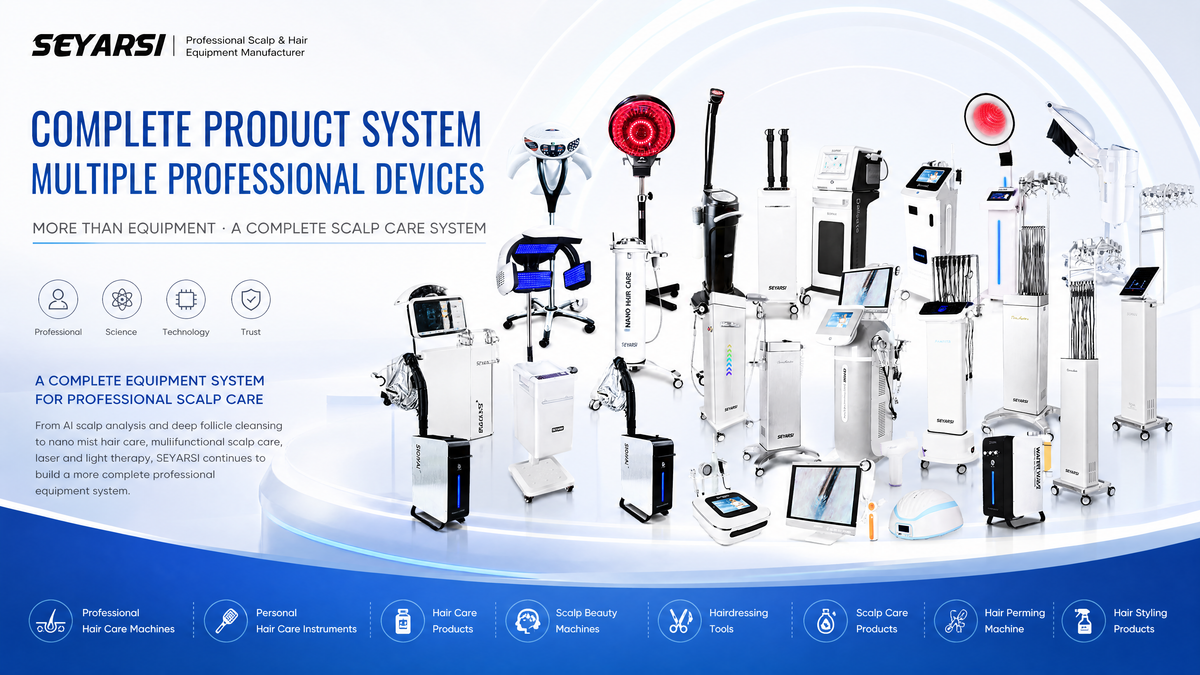
For salon groups, distributors and professional beauty brands, choosing scalp care equipment is not only about comparing machine functions or prices.
The more important question is: can the manufacturer support a stable, repeatable business model after the equipment arrives?
A professional scalp care project often involves consultation, service design, staff training, home-care recommendations, technical support and long-term maintenance. The right manufacturing partner should help make this process easier—not simply supply a machine.
This guide explains what to evaluate when choosing a professional scalp care equipment manufacturer for a salon, head spa, distribution business or OEM/ODM project.
1. Start With Your Business Model
Before comparing suppliers, clarify how you plan to use or sell the equipment.
Different business models need different levels of support:
- A salon may need equipment that is easy for staff to learn, fits its service time and can be added to existing hair-care appointments.
- A salon chain may need standardized workflows, consistent product quality and training materials for multiple locations.
- A distributor may need a focused product range, reliable supply, marketing materials and after-sales coordination.
- A professional beauty brand may need OEM or ODM support, including product appearance, branding, packaging and selected function customization.
A supplier may have many machines, but that does not automatically mean it is the right partner for your project. The better question is whether the manufacturer understands your target customer, service positioning and route to market.
2. Look Beyond a Long Function List
Professional scalp care equipment is often described with a long list of functions. But more functions are not always more useful.
A practical equipment setup should support a clear workflow, such as:
- Scalp consultation and visual assessment
- Cleansing or preparation
- Targeted professional care
- Relaxation or comfort step
- Home-care recommendation
- Follow-up consultation
When evaluating a machine, ask:
- Which service step does this function support?
- Is it easy for staff to explain to clients?
- Does it improve the service experience or only add complexity?
- Can it work with the salon’s existing shampoo, color or hair-care services?
- Is the operation time suitable for the salon’s appointment schedule?
For example, a professional scalp analyzer can improve consultation quality by making visible scalp and hair conditions easier to discuss. A pulse cleansing unit can support a dedicated cleansing step. A nano mist system may be used as part of a professional product-application experience. A multifunction device can help combine several care and relaxation steps into one structured service.
The best equipment is the equipment that helps staff deliver a consistent service—not the equipment with the longest specification sheet.
3. Check Whether the Manufacturer Understands Professional Workflows
A manufacturer should be able to explain how its equipment is used in a real professional setting.
Useful questions include:
- What is the recommended service flow?
- How long does one session normally take?
- Which type of salon or scalp care center is the equipment best suited for?
- What training is needed before staff can operate it confidently?
- Which professional products or home-care steps can be combined with the service?
- How should a salon guide clients toward regular follow-up visits?
This does not mean every manufacturer must operate salons directly. But it should understand the commercial reality of professional salons: limited space, limited staff time, client communication, service pricing and repeat-visit planning.
For a distributor, this is equally important. A machine is easier to sell when it comes with a clear usage scenario and a service story that local salon owners can understand.
4. Evaluate Product Stability and Long-Term Service
A machine is not a one-time purchase for a professional business. It becomes part of daily operations.
Before placing an order, ask about:
- Quality-control procedures during production
- Key components and practical service life
- User manuals and operation guidance
- Warranty terms and technical support
- Availability of replacement parts
- Remote troubleshooting process
- Packaging standards for international transportation
For distributors and salon groups, consistency between batches also matters. When you plan to expand a project across different locations or markets, you need equipment that remains stable in function, appearance and user experience.
A responsible manufacturing partner should communicate clearly about what it can support before the order is placed.
5. Consider Space, Power and Local Market Requirements
A machine may work well in one country but still require adaptation for another market.
Check practical details early:
- Voltage and plug requirements
- Product dimensions and shipping size
- Installation or space requirements
- Language options for screens, manuals or training materials
- Product labeling needs
- Local import documentation requirements
- Brand or distributor information that needs to appear on packaging
These details are especially important for distributors and OEM/ODM partners. Discussing them early can reduce avoidable delays later in the project.
For international business, the best partner is not simply the supplier that ships first. It is the supplier that helps you prepare the right product configuration and documentation for your market.
6. Understand the Difference Between OEM and ODM
OEM and ODM are often used together, but they are not the same.
OEM usually focuses on applying your existing brand identity to a standardized product. This may include a logo, packaging, color selection or other defined branding elements.
ODM involves a deeper level of customization. Depending on the project, it may include product appearance, structural adjustments, selected functions, user interface direction, packaging design and a complete professional project concept.
Before starting an OEM or ODM discussion, prepare:
- Your target market
- Your intended customer group
- Your estimated order volume
- Your preferred product style or brand direction
- Required functions and non-negotiable specifications
- Expected launch timeline
The clearer your brief, the more efficiently a manufacturer can evaluate feasibility, development time and cost.
7. Choose a Partner That Can Support Growth
A good supplier relationship should not end after shipment.
As your business grows, you may need:
- Additional equipment models
- Updated training materials
- New product configurations
- Market-specific branding
- Support for salon-project design
- More structured distributor materials
- Guidance on integrating equipment into a wider service system
This is why choosing a manufacturer is different from buying a single machine online. You are selecting a partner that may influence the quality, professionalism and scalability of your own business.
Final Thought: Choose a System, Not Just a Product
Professional scalp care is built on consultation, workflow, service quality and consistent follow-up. Equipment is an important part of that system, but it is not the whole system.
When selecting a professional scalp care equipment manufacturer, look for a partner that can combine practical equipment, stable production, clear communication, technical support and an understanding of how professional salons operate.
For salons, distributors and beauty brands, this creates a stronger foundation for building a scalp care project that can grow over time,
Chia sẻ:
Cách xây dựng thực đơn dịch vụ chăm sóc da đầu cho salon của bạn